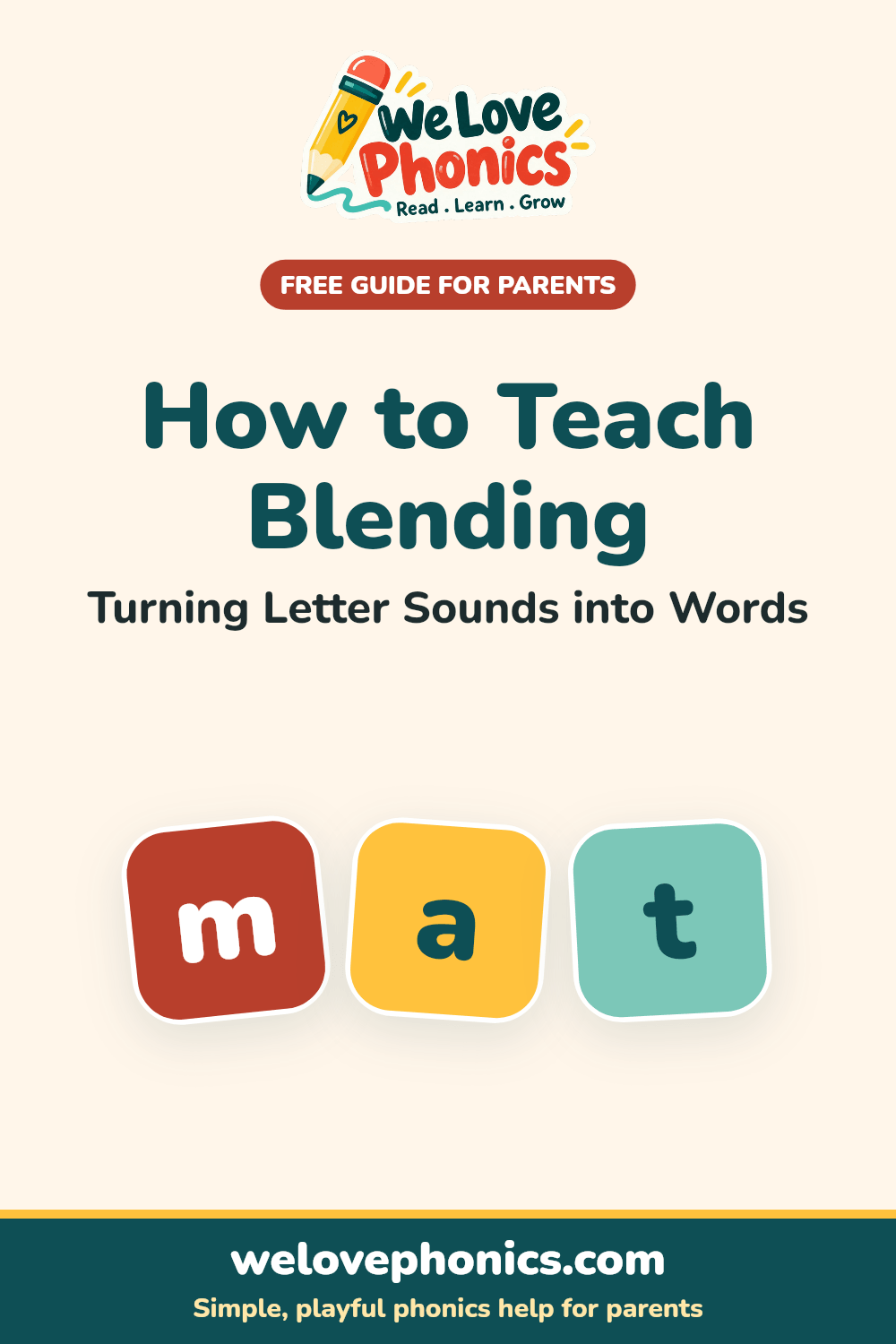
Your child knows a handful of letter sounds. They can tell you /s/, /a/ and /t/. But when you write sat, they say “/s/… /a/… /t/…” and then look at you, waiting. They have the sounds; they just can’t yet hear the word in them.
That missing step is blending: pushing individual sounds together so they become a word. It’s the moment letters turn into reading, and for many children it takes a while to click. This guide explains how to teach it, step by step, and what to try when it’s slow.
What blending is (and why it can be hard)
When we read sat, we don’t really say three separate sounds. The sounds run into each other. The /s/ slides into the /a/ and the /a/ stops at the /t/. Children who say each sound in isolation, with gaps between, end up with “/s/… /a/… /t/“, which their ears hear as three unrelated noises.
Blending is hard because it asks a child to do three things at once: remember each letter’s sound, hold the sounds in memory, and then listen to them as one word. That’s a lot of juggling for a four- or five-year-old. The methods below make the juggling easier.
Start with oral blending (no letters)
Before blending with letters, make sure your child can blend with their ears alone. Say a word in separate sounds and ask them to tell you the word.
“I’m thinking of an animal. /c/ /a/ /t/. What is it?”
Start with two sounds (/u/ /p/, up), then three. Use words for things in front of you. If your child can do this, they’re ready to blend written words. If they can’t, play this game for a few minutes every day, in the car, in the bath, at dinner, until they can. It’s the foundation for everything else.
Six ways to teach blending
1. Sound and sweep
Write a word in big lowercase letters. Point under each letter as your child says the sound, then sweep your finger under the whole word, quickly, while they say it all together. The sweep is the cue to blend. Do it yourself first, a few times, before asking your child to try.
2. Stretchy words
Choose a word that starts with a sound you can hold, like sat or man. Instead of separate sounds, stretch the word out like a piece of elastic: “sssaaat”. Then say it faster and faster until it snaps into sat. Starting with stretchy sounds (/s/, /m/, /f/, /n/, /l/) and avoiding gaps is often the breakthrough for children who are stuck.
3. Blend the first two sounds, then add the last
Instead of three sounds at once, blend in chunks: “/s/ /a/… sa. Sa… /t/… sat.” This takes some of the load off memory. It’s especially helpful for children who can say all the sounds but forget the first one by the time they reach the last.
4. Two-letter words first
If three-letter words are too much, go back to two: at, in, up, on, it, is. Then add a sound to the front: at becomes sat, mat, pat, cat. Your child sees that the end chunk stays the same, so they only need to blend one sound onto something they already know.
5. Sound buttons
Put a dot under each sound in a word: a dot under s, under a, under t. Your child presses each “button” as they say the sound, then slides their finger along to blend. When they meet digraphs like sh, a line under the two letters shows they make one sound. Our free CVC word cards use this style.
6. Hide and reveal
Cover a word with a card and slide it slowly to the right, revealing one letter at a time. Your child says each sound as it appears, keeping the sounds going without stopping, and then says the word. This naturally stops children from saying sounds in isolation with long gaps.
What words to use
The best first blending words are CVC words: consonant, vowel, consonant, like sat, pin, dog and cup. Use only letters your child knows well. If they’re shaky on m, don’t use mop yet. Our CVC words list groups words by the letter sounds children usually learn first.
Once CVC words feel easy, move to:
- Words with four sounds: stop, flag, lamp, tent
- Words with digraphs: ship, chop, thin, duck (see digraphs explained)
- Short phrases and sentences: a cat on a mat, the dog got wet
Mistakes that slow blending down
- Adding “uh” to sounds. “Suh-a-tuh” doesn’t become sat. Keep sounds clean (see letter sounds in order for how to say each one).
- Gaps between sounds. Teach your child to keep their voice going from one sound to the next, especially with stretchy sounds.
- Words that are too hard. If a word has a sound your child isn’t sure of, the whole thing falls apart. Choose words with secure sounds.
- Guessing. If your child sees s and says sun for sat, gently point back to each letter.
- Doing too many. Five or six words, read well, is a great session. Twenty is too many.
Try this tonight
Robot and fix-it
- Tell your child that a robot has come to dinner and can only talk in sounds.
- Be the robot: “Pass the
/c//u//p/.” Your child works out the word and passes the cup. - Swap roles. Your child is the robot, you blend.
- Now write three of the words on paper. Point and sweep while your child reads them.
Oral blending first, then the same words written down: it builds the bridge between hearing and reading.
How long does it take to learn to blend?
It varies a lot. Some children start blending within days of learning their first sounds; for others it takes weeks or months of short, regular practice. Neither is a sign of anything on its own. What matters is steady progress: a little easier this week than last.
If your child has been practicing for a while and still can’t blend simple words, our guide on how to help a child who can’t blend has more ideas. If you have concerns about your child’s hearing, speech or learning, talk to their teacher or your pediatrician.
Blending’s partner: segmenting
The reverse of blending is segmenting: hearing a word and breaking it into sounds, for spelling. “How many sounds in pig? /p/ /i/ /g/, three.” Practice both. Many children find segmenting a little easier, and it strengthens blending too.
Free: CVC word cards
Short words with a sound button under every sound, ready to cut out. Use them for sound-and-sweep practice and the hide-and-reveal game.
Frequently asked questions
What is blending in phonics?
Blending is saying the sounds in a written word and pushing them together to hear the word. For example, /s/ /a/ /t/ blended together is sat. It’s the core skill of reading with phonics.
At what age should a child be able to blend?
Many children begin blending simple words between four and six, but the range is wide. Look for steady progress rather than a particular age.
Should I teach blending or segmenting first?
Teach them side by side. Oral blending (hearing sounds and saying the word) and oral segmenting (hearing a word and saying its sounds) support each other.
My child can say all the sounds but can’t blend them. What should I do?
Go back to oral blending games without letters, use stretchy words that start with sounds like /s/ and /m/, and try blending the first two sounds before adding the last one.